Buy ninrp.nu ?
We are moving the project
ninrp.nu .
Are you interested in purchasing the domain
ninrp.nu ?
domain@kv-gmbh.de · 0541-91531010
Buy ninrp.nu ?
What is the difference between a power take-off shaft and a drive shaft?
A power take-off (PTO) shaft is a type of drive shaft that transfers power from a vehicle's engine to an attachment or implement, such as a pump or generator. The main difference between a PTO shaft and a regular drive shaft is that a PTO shaft is specifically designed to transfer power to external equipment, while a drive shaft is typically used to transfer power within a vehicle's transmission or between different components of a vehicle. Additionally, PTO shafts are often detachable and can be connected and disconnected as needed, whereas a drive shaft is a permanent component of a vehicle's drivetrain. **
What is a Ridex cabin air filter?
A Ridex cabin air filter is a type of air filter designed specifically for the cabin of a vehicle. It is installed in the HVAC system of the car to help improve the air quality inside the cabin by filtering out dust, pollen, and other airborne particles. This can help reduce allergens and pollutants inside the vehicle, creating a cleaner and healthier environment for the occupants. Ridex cabin air filters are typically made with high-quality materials and are designed to be a direct replacement for the original filter in the vehicle. **


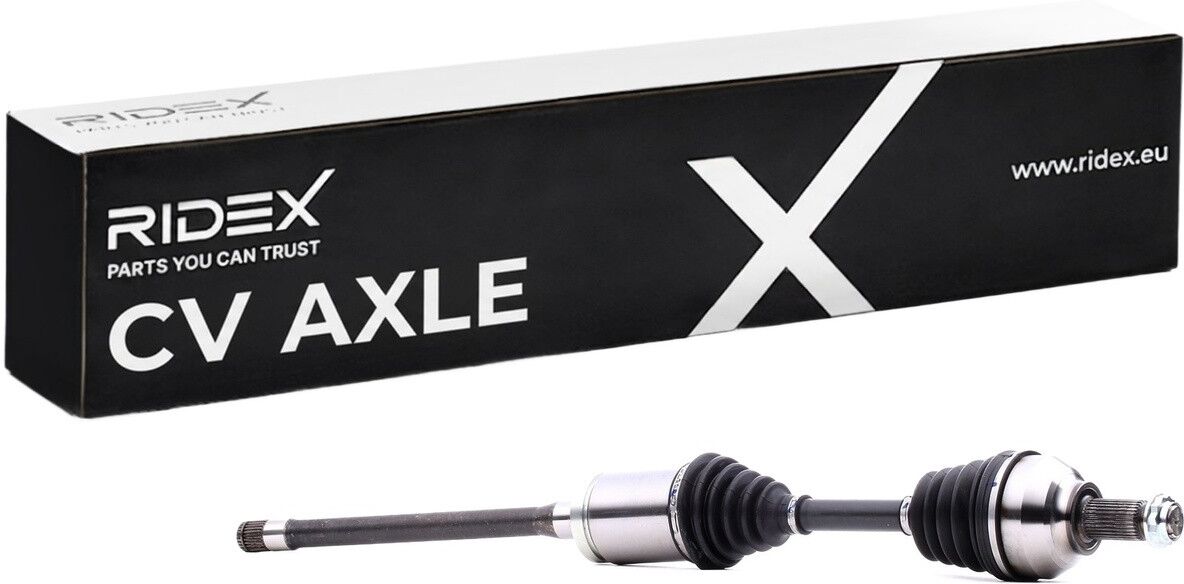
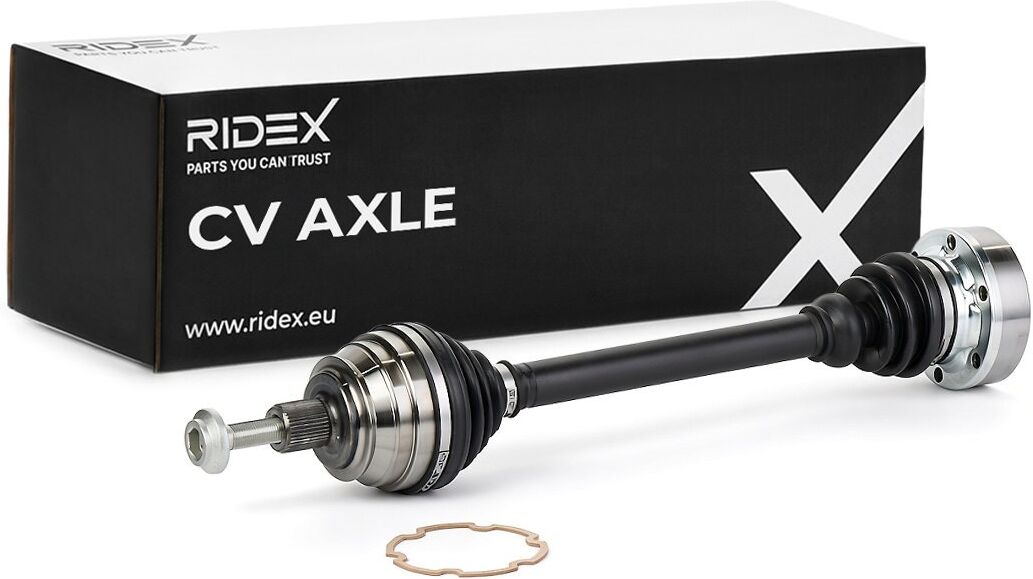
Similar search terms for RIDEX-1427J0014-Drive-shaft
Top-Angebote
Products related to RIDEX-1427J0014-Drive-shaft:
-
RIDEX 13D0109 Drive shaftFitting Position: Front Axle Right; Length [mm]: 901; External Toothing wheel side: 30; External Toothing differential side: 27; Braking/Driving Dynamics: for vehicles with ABS; Wheel-sided joint diameter [mm]: 98; Transmission-sided joint diameter [mm]: 86; Tripod roller diameter [mm]: 43,2089,49 £*Shipping: 8,45 £Secure redirect to the provider
-
RIDEX 13D0006 Drive shaftLength [mm]: 537; Bore Diameter [mm]: 10,5; Thread Size: M16x1.5; External Toothing wheel side: 38; Seal Ring Diameter [mm]: 60; Number of bores: 6; Bolt Hole Circle Ø [mm]: 94; Transmission-sided joint diameter [mm]: 108; Internal Gearing Diff. Side (connecting shaft connection): 28; Internal Toothing wheel side: 27; Fitting Position: Front Axle, Front Axle Left, Front Axle Right; Construction Year from: 01/1996; Vehicle Identification Number (VIN) from: 70-T-200000, 70-T-200001; Braking/Driving Dynamics: for vehicles without ABS; Transmission Type: Manual Transmission, Fully Automatic58,49 £*Shipping: 8,45 £Secure redirect to the provider
-
RIDEX 13D0229 Drive shaftLength [mm]: 840; Thread Size: M20 x 1,5; External Toothing differential side: 24; External Toothing wheel side: 21; Diameter 1 [mm]: 86,5; Diameter 2 [mm]: 70,5; Seal Ring Diameter [mm]: 56; Fitting Position: Front Axle Right; Transmission Code: BE1/3, BE1; Construction Year to: 12/1989; Vehicle Identification Number (VIN): Ch. -6749; Vehicle Identification Number (VIN) to: 6749; Transmission Type: Fully Automatic; Construction Year from: 07/198751,99 £*Shipping: 8,45 £Secure redirect to the provider


-
Why are there no simple motorcycles with shaft drive or belt drive?
There are no simple motorcycles with shaft drive or belt drive because these systems are more complex and expensive to manufacture compared to chain drive systems. Chain drives are simpler, lighter, and more cost-effective, making them the preferred choice for most motorcycles. Additionally, chain drives offer easier maintenance and customization options, which are important factors for many motorcycle enthusiasts. Overall, the simplicity and efficiency of chain drives make them the more popular choice in the motorcycle industry. **
-
How to calculate the moment of inertia of the drive shaft?
To calculate the moment of inertia of the drive shaft, you need to know the mass of the shaft and its distribution along its length. The moment of inertia can be calculated using the formula I = ∫r^2 dm, where r is the distance from the axis of rotation to the element of mass dm. By integrating this formula over the entire length of the shaft, you can determine the moment of inertia of the drive shaft. Alternatively, you can also use the parallel axis theorem to calculate the moment of inertia if the shaft is not rotating about its center of mass. **
-
Which materials are used for the gearbox input shaft?
The gearbox input shaft is typically made from high-strength steel or alloy materials such as 4340 or 4140 steel. These materials are chosen for their high tensile strength, hardness, and resistance to wear and fatigue. Additionally, some input shafts may also be coated with surface treatments such as nitriding or shot peening to further enhance their durability and performance under heavy loads and high speeds. Overall, the materials used for the gearbox input shaft are selected to withstand the demanding conditions and forces experienced within the transmission system. **
-
How do you calculate the moment of inertia of the drive shaft?
The moment of inertia of a drive shaft can be calculated using the formula for the moment of inertia of a solid cylinder, which is \( I = \frac{1}{2} m r^2 \), where \( m \) is the mass of the shaft and \( r \) is the radius of the shaft. If the drive shaft is not a solid cylinder, the moment of inertia can be calculated by summing the moments of inertia of its individual components using the parallel axis theorem. This involves calculating the moment of inertia of each component about its own center of mass and then adding the mass of each component multiplied by the square of the distance between its center of mass and the axis of rotation. **

What tools, materials, and equipment do teachers work with?
Teachers work with a variety of tools, materials, and equipment in their daily work. Some common tools include whiteboards, markers, and projectors for delivering lessons. Materials such as textbooks, worksheets, and manipulatives are used to support student learning. Equipment like computers, printers, and audio-visual devices are also essential for creating engaging lessons and activities. Overall, teachers rely on a combination of traditional and modern tools to effectively educate their students. **
What about the shaft?
The shaft is a long, narrow part of a structure or object that typically provides support or serves as a passageway. In the context of machinery or equipment, the shaft is often used to transmit power or motion from one part to another. It is important to ensure that the shaft is properly aligned, lubricated, and maintained to prevent wear and damage, which can lead to equipment failure. **
Top-Angebote
Products related to RIDEX-1427J0014-Drive-shaft:
-
RIDEX 13D0104 Drive shaftFitting Position: Front Axle Right, Front Axle Left; Length [mm]: 135,5; External Toothing wheel side: 26; External Toothing differential side: 42; Vehicle type: Caravelle, Transporter, California, Transporter Shuttle; Transmission Type: 6-Speed Manual Transmission; Construction Year from: 02/2004, 07/2004, 09/2009, 05/2008, 01/2006, 06/2005, 04/2011, 01/2010; Construction Year to: 05/2013, 11/200930,99 £*Shipping: 8,45 £Secure redirect to the provider
-
RIDEX 13D0109 Drive shaftFitting Position: Front Axle Right; Length [mm]: 901; External Toothing wheel side: 30; External Toothing differential side: 27; Braking/Driving Dynamics: for vehicles with ABS; Wheel-sided joint diameter [mm]: 98; Transmission-sided joint diameter [mm]: 86; Tripod roller diameter [mm]: 43,2089,49 £*Shipping: 8,45 £Secure redirect to the provider
-
RIDEX 13D0006 Drive shaftLength [mm]: 537; Bore Diameter [mm]: 10,5; Thread Size: M16x1.5; External Toothing wheel side: 38; Seal Ring Diameter [mm]: 60; Number of bores: 6; Bolt Hole Circle Ø [mm]: 94; Transmission-sided joint diameter [mm]: 108; Internal Gearing Diff. Side (connecting shaft connection): 28; Internal Toothing wheel side: 27; Fitting Position: Front Axle, Front Axle Left, Front Axle Right; Construction Year from: 01/1996; Vehicle Identification Number (VIN) from: 70-T-200000, 70-T-200001; Braking/Driving Dynamics: for vehicles without ABS; Transmission Type: Manual Transmission, Fully Automatic58,49 £*Shipping: 8,45 £Secure redirect to the provider
-
What is the difference between a power take-off shaft and a drive shaft?
A power take-off (PTO) shaft is a type of drive shaft that transfers power from a vehicle's engine to an attachment or implement, such as a pump or generator. The main difference between a PTO shaft and a regular drive shaft is that a PTO shaft is specifically designed to transfer power to external equipment, while a drive shaft is typically used to transfer power within a vehicle's transmission or between different components of a vehicle. Additionally, PTO shafts are often detachable and can be connected and disconnected as needed, whereas a drive shaft is a permanent component of a vehicle's drivetrain. **
-
What is a Ridex cabin air filter?
A Ridex cabin air filter is a type of air filter designed specifically for the cabin of a vehicle. It is installed in the HVAC system of the car to help improve the air quality inside the cabin by filtering out dust, pollen, and other airborne particles. This can help reduce allergens and pollutants inside the vehicle, creating a cleaner and healthier environment for the occupants. Ridex cabin air filters are typically made with high-quality materials and are designed to be a direct replacement for the original filter in the vehicle. **
-
Why are there no simple motorcycles with shaft drive or belt drive?
There are no simple motorcycles with shaft drive or belt drive because these systems are more complex and expensive to manufacture compared to chain drive systems. Chain drives are simpler, lighter, and more cost-effective, making them the preferred choice for most motorcycles. Additionally, chain drives offer easier maintenance and customization options, which are important factors for many motorcycle enthusiasts. Overall, the simplicity and efficiency of chain drives make them the more popular choice in the motorcycle industry. **
-
How to calculate the moment of inertia of the drive shaft?
To calculate the moment of inertia of the drive shaft, you need to know the mass of the shaft and its distribution along its length. The moment of inertia can be calculated using the formula I = ∫r^2 dm, where r is the distance from the axis of rotation to the element of mass dm. By integrating this formula over the entire length of the shaft, you can determine the moment of inertia of the drive shaft. Alternatively, you can also use the parallel axis theorem to calculate the moment of inertia if the shaft is not rotating about its center of mass. **
Similar search terms for RIDEX-1427J0014-Drive-shaft
-
RIDEX 13D0229 Drive shaftLength [mm]: 840; Thread Size: M20 x 1,5; External Toothing differential side: 24; External Toothing wheel side: 21; Diameter 1 [mm]: 86,5; Diameter 2 [mm]: 70,5; Seal Ring Diameter [mm]: 56; Fitting Position: Front Axle Right; Transmission Code: BE1/3, BE1; Construction Year to: 12/1989; Vehicle Identification Number (VIN): Ch. -6749; Vehicle Identification Number (VIN) to: 6749; Transmission Type: Fully Automatic; Construction Year from: 07/198751,99 £*Shipping: 8,45 £Secure redirect to the provider
-
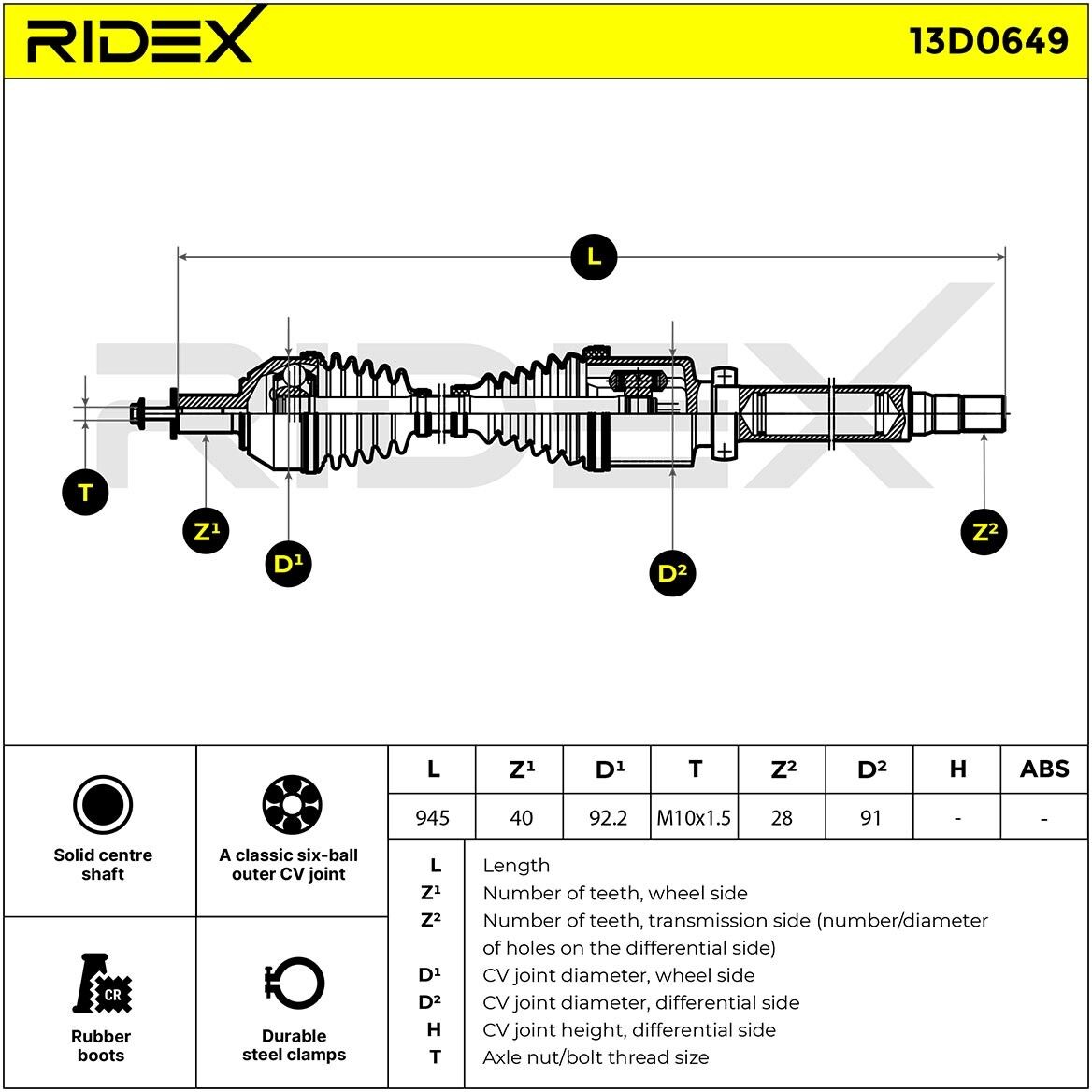
RIDEX 13D0649 Drive shaftLength [mm]: 950; Fitting Position: Front Axle Right; External Toothing wheel side: 40; External Toothing differential side: 28; Construction Year from: 03/2010; Transmission Type: Fully Automatic; Transmission Number: MPS6144,99 £*Shipping: 1,99 £Secure redirect to the provider
-
RIDEX 13D0657 Drive shaftLength [mm]: 635; Thread Size: M24x1.5; External Toothing wheel side: 25; External Toothing differential side: 24; Seal Ring Diameter [mm]: 58,4; Length 2 [mm]: 62; Wheel-sided joint diameter [mm]: 86; Transmission-sided joint diameter [mm]: 83; Fitting Position: Front Axle Left; Transmission Code: BE4R; Transmission Type: Manual Transmission; Engine Code: EP6DT, EP6DTS, DV6TED4, EP6C, DV6DTED, DV6C, DV6EF61,99 £*Shipping: 8,45 £Secure redirect to the provider
-
Which materials are used for the gearbox input shaft?
The gearbox input shaft is typically made from high-strength steel or alloy materials such as 4340 or 4140 steel. These materials are chosen for their high tensile strength, hardness, and resistance to wear and fatigue. Additionally, some input shafts may also be coated with surface treatments such as nitriding or shot peening to further enhance their durability and performance under heavy loads and high speeds. Overall, the materials used for the gearbox input shaft are selected to withstand the demanding conditions and forces experienced within the transmission system. **
-
How do you calculate the moment of inertia of the drive shaft?
The moment of inertia of a drive shaft can be calculated using the formula for the moment of inertia of a solid cylinder, which is \( I = \frac{1}{2} m r^2 \), where \( m \) is the mass of the shaft and \( r \) is the radius of the shaft. If the drive shaft is not a solid cylinder, the moment of inertia can be calculated by summing the moments of inertia of its individual components using the parallel axis theorem. This involves calculating the moment of inertia of each component about its own center of mass and then adding the mass of each component multiplied by the square of the distance between its center of mass and the axis of rotation. **
-
What tools, materials, and equipment do teachers work with?
Teachers work with a variety of tools, materials, and equipment in their daily work. Some common tools include whiteboards, markers, and projectors for delivering lessons. Materials such as textbooks, worksheets, and manipulatives are used to support student learning. Equipment like computers, printers, and audio-visual devices are also essential for creating engaging lessons and activities. Overall, teachers rely on a combination of traditional and modern tools to effectively educate their students. **
-
What about the shaft?
The shaft is a long, narrow part of a structure or object that typically provides support or serves as a passageway. In the context of machinery or equipment, the shaft is often used to transmit power or motion from one part to another. It is important to ensure that the shaft is properly aligned, lubricated, and maintained to prevent wear and damage, which can lead to equipment failure. **
* All prices are inclusive of VAT and, if applicable, plus shipping costs. The offer information is based on the details provided by the respective shop and is updated through automated processes. Real-time updates do not occur, so deviations can occur in individual cases. ** Note: Parts of this content were created by AI.